
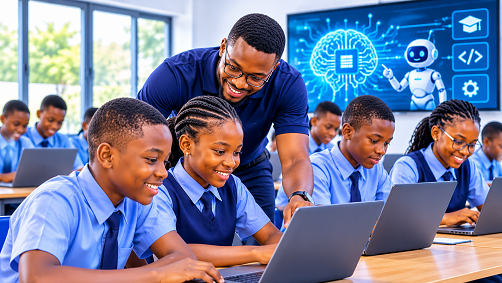
Technology is transforming almost every aspect of modern life. Artificial intelligence is changing how people work, businesses operate, information is processed, and solutions are developed. Software powers industries, robotics is transforming production, and digital systems are increasingly becoming essential to everyday activities.
Yet, despite these developments, many students across Africa still experience computer education primarily as a theoretical subject.
They learn about computers, study basic applications, and sometimes acquire introductory digital literacy skills. However, opportunities to write actual code, build software, experiment with artificial intelligence, develop digital products, and solve practical technology problems remain limited in many school environments.
This presents an important question: Are we preparing students to participate in the digital future, or simply teaching them to use the technology that already exists?
This is the question behind Applinet TechBridge, an educational technology initiative by Applinet Technology designed to transform how students experience technology education.
What Is Applinet TechBridge?
Applinet TechBridge is a practical technology education programme that partners with schools to introduce structured, hands-on technology learning to students, beginning with Junior Secondary School 1, 2, and 3 (JSS1–JSS3).
The programme combines classroom instruction with an integrated digital learning environment, giving students opportunities to learn, practise, experiment, collaborate, and build.
Its educational approach covers areas such as:
-
Software development and programming. -
Artificial intelligence and AI literacy. -
Robotics and computational thinking. -
Cybersecurity and digital safety. -
Web development and digital creativity. -
Computer fundamentals and technology literacy. -
Collaborative technology projects and problem-solving.
Rather than limiting students to theoretical explanations, TechBridge encourages them to interact with technology and understand how digital products and systems are created.
The programme is built around a simple principle: students learn technology more meaningfully when they have opportunities to use it.
Connecting Classroom Learning With an Online Practical Learning Environment
One of the defining features of TechBridge is that learning does not end when students leave the school premises.
Through the TechBridge online portal, students have access to a digital learning environment that extends their classroom experience beyond school hours.
This means students can continue learning, practising, and developing their skills at home.
The portal is designed to connect classroom lessons with practical digital activities, giving students a more continuous learning experience.
1. Lessons: Learning Beyond the Classroom
Students can access structured lessons through their online learning environment.
These lessons complement what instructors teach in school and provide opportunities for students to revisit topics, strengthen their understanding, and prepare for upcoming classes.
A student who does not fully understand a programming concept during a classroom session can return to the lesson later and study it again.
This makes learning more flexible and encourages students to take greater responsibility for their education.
2. Code Studio: A Practical Coding Environment
TechBridge introduces students to practical programming through its online Code Studio.
Instead of requiring students to depend entirely on external coding applications, the platform provides an environment where they can write, execute, test, and experiment with code.
Students can practise programming from home, explore different coding concepts, and gradually develop their ability to create digital solutions.
The learning environment is intended to support languages and technologies such as Python, JavaScript, HTML, and CSS.
For example, a student learning HTML and CSS can practise building a simple webpage. Another student learning Python can experiment with variables, conditions, loops, and other programming concepts.
This is an important distinction between simply learning about programming and actually learning how to program.
Students are not just reading code. They are writing it, running it, testing it, and learning from the results.
3. Tasks and Assignments: Learning Through Practice
The portal also provides a structured environment for instructors to assign practical tasks and learning activities.
Students can receive assignments, work on them outside the classroom, and submit their completed work through the platform.
This creates a connection between classroom instruction and independent practice.
Rather than depending exclusively on written homework, students can engage in activities that require them to apply what they have learned.
Instructors can monitor submissions and provide feedback to support continuous improvement.
4. Quiz Arena: Making Learning Interactive
Learning should not always feel like an examination.
Through interactive quizzes and knowledge challenges, TechBridge creates opportunities for students to test their understanding, reinforce concepts, and engage with lessons in a more interactive way.
Students can participate in assessments that help them identify what they understand and where they need additional practice.
The platform also creates opportunities for friendly competitions and learning challenges that encourage participation and healthy academic engagement.
5. Projects: Turning Ideas Into Digital Products
Technology education becomes more meaningful when students have opportunities to build something of their own.
TechBridge encourages project-based learning, allowing students to apply the knowledge they acquire through practical assignments and collaborative activities.
Students can work individually or in teams to develop projects that demonstrate their understanding of technology.
These projects could include websites, simple software applications, programming exercises, robotics concepts, and other digital solutions.
The intention is to help students develop more than technical knowledge. They also learn planning, creativity, communication, teamwork, and problem-solving.
6. Team Collaboration: Learning to Build Together
Most significant technology products are developed through collaboration.
TechBridge introduces students to collaborative learning through team-based activities and projects.
Students can work together, contribute ideas, share responsibilities, and participate in group challenges.
This encourages them to understand that technology development involves communication, teamwork, experimentation, and continuous improvement.
It also creates an opportunity for students to develop leadership and collaborative skills from an early age.
Bringing Artificial Intelligence Into the Learning Experience
Artificial intelligence presents an opportunity to make technology education more interactive, adaptive, and accessible.
TechBridge's broader vision is to integrate AI into the learning experience in ways that support both students and instructors.
Imagine a student who encounters a difficult programming concept at home. An AI-powered learning assistant could provide an explanation, offer examples, and guide the student through the problem.
Imagine an instructor preparing a lesson and using AI-assisted tools to develop exercises, generate assessment questions, and identify different ways to explain a difficult concept.
Imagine a learning platform that can analyse assessment performance and recommend lessons or exercises based on the areas where a student needs improvement.
These are some of the opportunities AI integration creates for TechBridge.
The goal is not to encourage students to depend on AI to complete their assignments. It is to teach them how to use intelligent tools responsibly, critically, and productively.
Artificial intelligence should support thinking, not replace it.
The Role of Instructors: Human Guidance Supported by Technology
Although TechBridge embraces digital learning and artificial intelligence, instructors remain central to its educational model.
The programme brings technology education into schools through practical instruction delivered by instructors with relevant technology knowledge and experience.
Instructors introduce concepts, guide practical exercises, supervise projects, assess understanding, and help students navigate technical challenges.
The online portal complements this process by giving instructors and students a shared digital environment for lessons, tasks, projects, quizzes, and learning activities.
This combination of human instruction and digital infrastructure creates opportunities for a more connected learning experience.
Technology becomes a tool that strengthens teaching rather than a replacement for the teacher.
A Progressive Learning Journey: JSS1 to JSS3
TechBridge recognises that students need a structured learning progression.
Its JSS1–JSS3 model provides an opportunity to introduce foundational concepts and gradually move towards more practical and advanced applications.
JSS1 – Discover and Explore
Students are introduced to digital literacy, computer fundamentals, computational thinking, introductory programming, and foundational AI concepts.
The emphasis is on curiosity, understanding, and building confidence.
JSS2 – Create and Experiment
Students progress into more practical programming, web development, AI-assisted problem-solving, introductory robotics, and cybersecurity awareness.
They begin applying their knowledge through practical exercises and digital projects.
JSS3 – Build and Innovate
Students strengthen their technical understanding through more substantial programming activities, collaborative projects, practical challenges, and advanced technology concepts.
The objective is to help them develop the confidence to turn ideas into working digital solutions.
By building progressively, TechBridge seeks to establish a foundation upon which students can continue developing their technology skills throughout secondary education and beyond.
Benefits for Schools
TechBridge is designed to provide schools with more than an additional computer studies programme.
It offers an opportunity to strengthen their technology education infrastructure through a combination of specialised instruction and a supporting digital platform.
Participating schools can benefit from:
-
Structured practical technology education.
-
Access to instructors focused on technology skills development.
-
A digital learning environment for students.
-
Online coding and practical exercises.
-
Structured lessons, assignments, and assessments.
-
Collaborative projects and student engagement activities.
-
Digital monitoring of learning activities and progress.
-
Early exposure to artificial intelligence and emerging technologies.
Through this model, schools can expand the learning opportunities available to their students without having to independently develop an entire technology education programme and supporting platform.
Why We Believe This Matters for Africa
Africa's participation in the global digital economy must go beyond the consumption of technologies developed elsewhere.
The continent needs young people who can understand technological systems, develop software, work with artificial intelligence, solve problems, and create products that address real challenges.
These abilities should not be introduced only when students reach university or enter the workforce.
They can begin developing much earlier.
A student who discovers programming in JSS1 may develop an interest in software engineering. Another who experiments with robotics may discover an interest in engineering. A student introduced to artificial intelligence may become interested in machine learning, data science, or research.
The purpose of early technology education is not to force every student into a technology career. It is to give them the knowledge and exposure to make informed choices about the opportunities available to them.
We believe that African students should have the opportunity to become participants in technological innovation, not just consumers of digital products.
The Bigger Vision: An Intelligent Learning Infrastructure for African Schools
TechBridge represents a broader ambition for Applinet Technology.
We envision a scalable digital education platform that connects schools, instructors, and students through practical technology learning and intelligent educational tools.
The long-term direction includes further development of AI-powered learning assistants, instructor support systems, adaptive assessments, intelligent learning recommendations, coding assistance, collaborative development environments, and school performance analytics.
By connecting physical classroom instruction with an online learning platform, TechBridge can progressively extend its reach beyond individual school visits and classroom sessions.
The opportunity is to build an education technology infrastructure that supports continuous learning, practical skill development, and measurable student progress across multiple schools.
This is particularly important in an era where access to quality technology education can influence how young people participate in the future economy.
Join Us in Building the Future of Technology Education
The transformation of education requires collaboration between technology companies, schools, educators, parents, and institutions that recognise the importance of preparing young people for the future.
Applinet TechBridge invites schools to explore partnerships that bring practical technology education into their classrooms.
We believe that every student deserves an opportunity to understand technology, experiment with it, and discover what they can create.
Our ambition is to make technology education more practical, engaging, accessible, and relevant to the world students are growing into.
Because the future will not be built by people who only know how to use technology. It will also be built by those who understand how to create it.
Applinet TechBridge — Learn. Build. Innovate. Lead.
An initiative of Applinet Technology.
Building Africa's Digital Future, One Classroom at a Time.
 Log in with Google


Join the conversation
Share your thoughts and perspectives.
Your voice matters.
Sign in to share your thoughts, join discussions and connect with other readers.
Sign in to commentBe the first to share your thoughts.