
Stop Overgeneralizing:
One Experience Is Not Your Whole Story
How one bad experience quietly becomes a lifelong belief—and how changing your thinking changes your future.
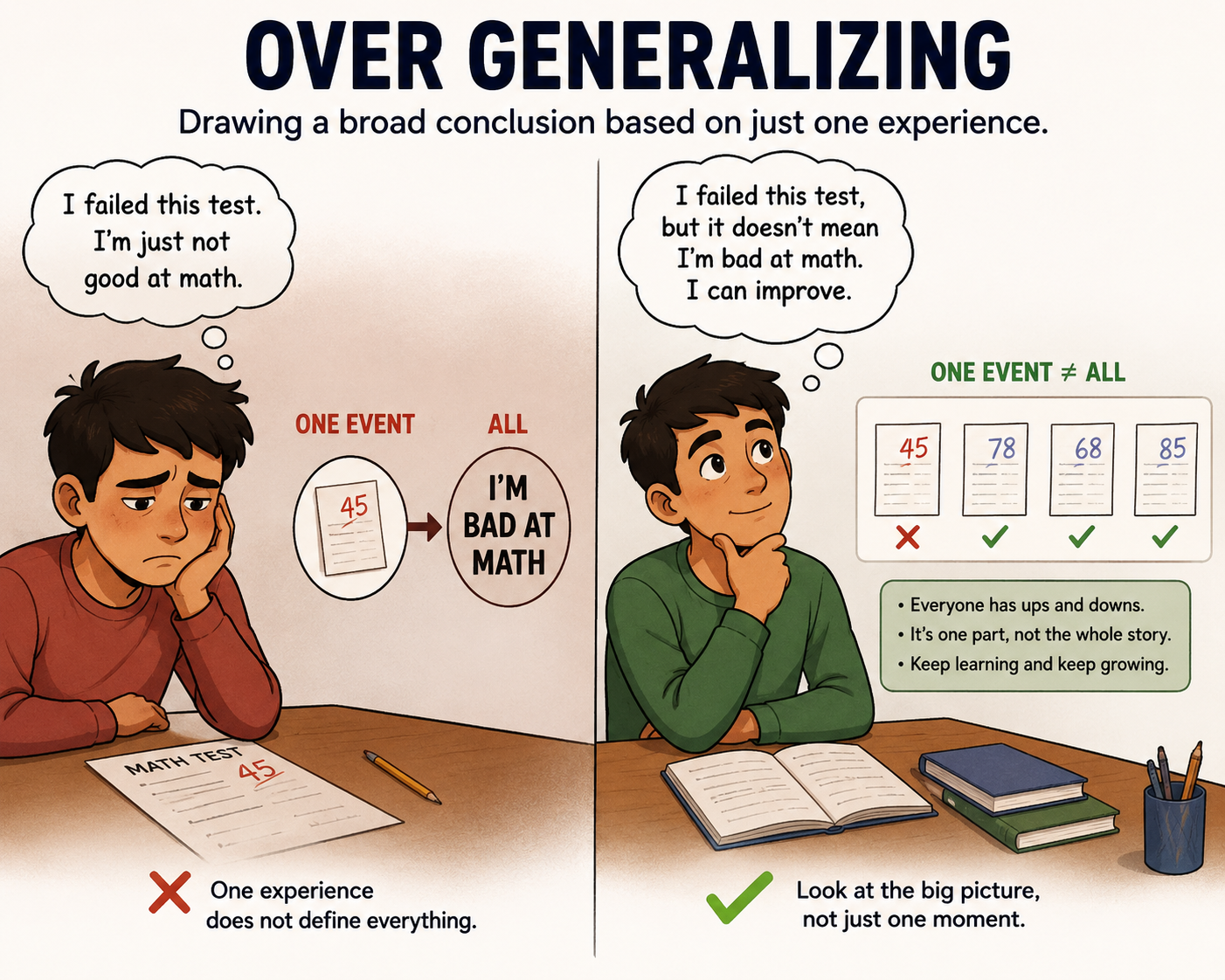
Have you ever failed once and immediately concluded, "I'm just not good enough."
Or perhaps you started a business that didn't work, and from that single experience decided that entrepreneurship wasn't for you.
These conclusions may seem logical at first, but they are often examples of a common thinking error called overgeneralization.
“Your past is evidence, not a prophecy.”
What is Overgeneralization?
Overgeneralization happens when we take one event and use it to define every future possibility.
Instead of seeing a setback as one isolated experience, we unconsciously turn it into a permanent identity.
"This happened once." becomes "This will always happen."
Everyday Examples
❌ Fixed Thinking
I failed WAEC.
Therefore...
"I'm not intelligent."
✔ Growth Thinking
I failed WAEC.
Therefore...
"I need another strategy."
❌ Fixed Thinking
Started one business.It failed.
Therefore...
Business isn't for me.
✔ Growth Thinking
Started one business.
Learned valuable lessons.
Next business will be wiser.
Why This Happens
Our brains naturally search for patterns.
Unfortunately, when emotions are involved, we often create patterns that don't actually exist.
One rejection becomes:
"Is this really true... or am I making a conclusion from one experience?"
Overgeneralization in the African Context
Across Africa, many beliefs are formed through repeated exposure to difficult circumstances. While some concerns are rooted in real experiences, we sometimes extend one experience—or even a series of experiences—into an absolute conclusion.
This doesn't mean the challenges are imaginary. Economic hardship, unemployment, poor infrastructure, corruption, insecurity, and educational inequality are genuine issues in many places. The thinking error happens when we conclude that because these challenges exist today, improvement is impossible tomorrow.
- No business survives here.
- Government never changes.
- Technology is only for developed countries.
- Nobody from my village succeeds.
- Challenges create opportunities.
- Systems improve through people.
- Innovation starts locally.
- My background doesn't determine my future.
Infographic: How Overgeneralization Works
What Research Says
Dr. Aaron Beck
Dr. David Burns
Dr. Carol Dweck
Daniel Kahneman
- One failure doesn't define your future.
- Learn before drawing conclusions.
- Replace assumptions with evidence.
- Every expert started as a beginner.
- Growth comes through continuous learning.
- Challenge your thinking every day.
📚 Mindset for Growth Series
Discover how thinking errors quietly shape our choices and why healthy thinking is the foundation of lasting success. 2. Common Thinking Errors
Learn to identify overgeneralization, catastrophizing, mind reading, emotional reasoning, labeling, and other common cognitive distortions. 3. Technology & the Human Mind
Explore how technology can strengthen—or weaken—our thinking, attention, and decision-making. 4. Education Beyond Certificates
Why lifelong learning matters more than collecting qualifications alone. 5. Relationship, Marriage & Healthy Thinking
Discover how thinking patterns influence communication, trust, forgiveness, and lasting relationships. 6. Building Africa with a Growth Mindset
How healthier thinking can contribute to innovation, ethical leadership, education, entrepreneurship, and community development. 7. Becoming the Architect of Your Future
Bring everything together into a practical roadmap for building a life of purpose, resilience, and positive impact.
Think About This
Could one belief you've accepted about yourself, your family, your career, or your country actually be a thinking error rather than an unchangeable fact?
Coming Next →
Common Thinking Errors That Quietly Control People's Lives
You'll probably recognize yourself in at least one of them—and you'll learn practical ways to challenge those patterns with healthier, evidence-based thinking.
Read Article 3 Technology & the Human Mind Log in with Google


Join the conversation
Share your thoughts and perspectives.
Your voice matters.
Sign in to share your thoughts, join discussions and connect with other readers.
Sign in to commentBe the first to share your thoughts.